
Have you ever noticed how some letters seem uncommon in scientific vocabulary, yet they unlock some of the most fascinating concepts in science? Science words that start with V are excellent examples. From biology and medicine to physics, chemistry, astronomy, technology, and environmental science, these terms help explain natural processes, scientific discoveries, measurements, and advanced systems. Learning science words that start with V not only expands your scientific knowledge but also strengthens your academic vocabulary and understanding of the world around you.
Why Science Words Starting With V Matter
Science vocabulary plays a critical role in understanding scientific concepts, research papers, classroom lessons, and real-world discoveries. Many science words that start with V describe important biological structures, chemical properties, physical phenomena, technological innovations, and medical processes.
Benefits of learning these terms include:
- Improving scientific literacy.
- Expanding academic vocabulary.
- Enhancing classroom performance.
- Supporting research and communication skills.
- Making complex scientific concepts easier to understand.
- Building confidence in STEM subjects.
Whether you are a student, teacher, researcher, or science enthusiast, learning these words can deepen your understanding of various scientific disciplines.
Physics Science Words That Start With V
Physics explores matter, energy, forces, and motion. Many important physics terms begin with the letter V.
Physics Terms and Meanings
- Vacuum – A space with little or no matter.
- Velocity – Speed in a specific direction.
- Vector – A quantity with magnitude and direction.
- Vibration – Rapid back-and-forth motion.
- Volt – Unit of electrical potential difference.
- Voltage – Electrical force that drives current.
- Viscosity – Resistance of a fluid to flow.
- Volume – Amount of space occupied by matter.
- Venturi Effect – Pressure reduction in flowing fluids.
- Van der Waals Force – Weak attraction between molecules.
- Virtual Image – Image formed by reflected or refracted light.
- Vortex – Circular motion of a fluid.
- Vacuum Energy – Energy present in empty space.
- Velocity Vector – Directional representation of velocity.
- Vibrational Energy – Energy due to oscillation.
- Voltage Drop – Reduction in electrical potential.
- Variable Force – Force that changes in magnitude.
- Vertical Motion – Movement up or down.
- Viscous Drag – Resistance exerted by fluids.
- Velocity Gradient – Rate of velocity change in a fluid.
Chemistry Science Words That Start With V
Chemistry studies substances, reactions, and molecular interactions. The letter V contributes many important chemical terms.
Chemistry Terms and Meanings
- Valence – Combining capacity of an atom.
- Valence Electron – Electron in the outer shell.
- Vapor – Gas form of a substance.
- Vaporization – Conversion of liquid into gas.
- Volatile – Easily evaporated substance.
- Viscosity – Thickness or flow resistance of liquids.
- Volumetric Analysis – Chemical analysis using volume measurements.
- Vial – Small container for chemicals.
- Vinyl Group – Organic functional group.
- Vanadium – Chemical element with atomic number 23.
- Vacuum Distillation – Distillation under reduced pressure.
- Volumetric Flask – Laboratory measuring flask.
- Vitreous State – Glass-like non-crystalline state.
- Vapor Pressure – Pressure exerted by vapor.
- Valency – Number of bonds an atom forms.
- Viscometer – Instrument for measuring viscosity.
- Volatilization – Process of becoming vapor.
- Vulcanization – Chemical treatment of rubber.
- Vanillin – Organic compound responsible for vanilla flavor.
- Vibrational Spectroscopy – Technique for studying molecular vibrations.
Biology Science Words That Start With V
Biology examines living organisms and life processes. Many biological terms begin with V.
Biology Terms and Meanings
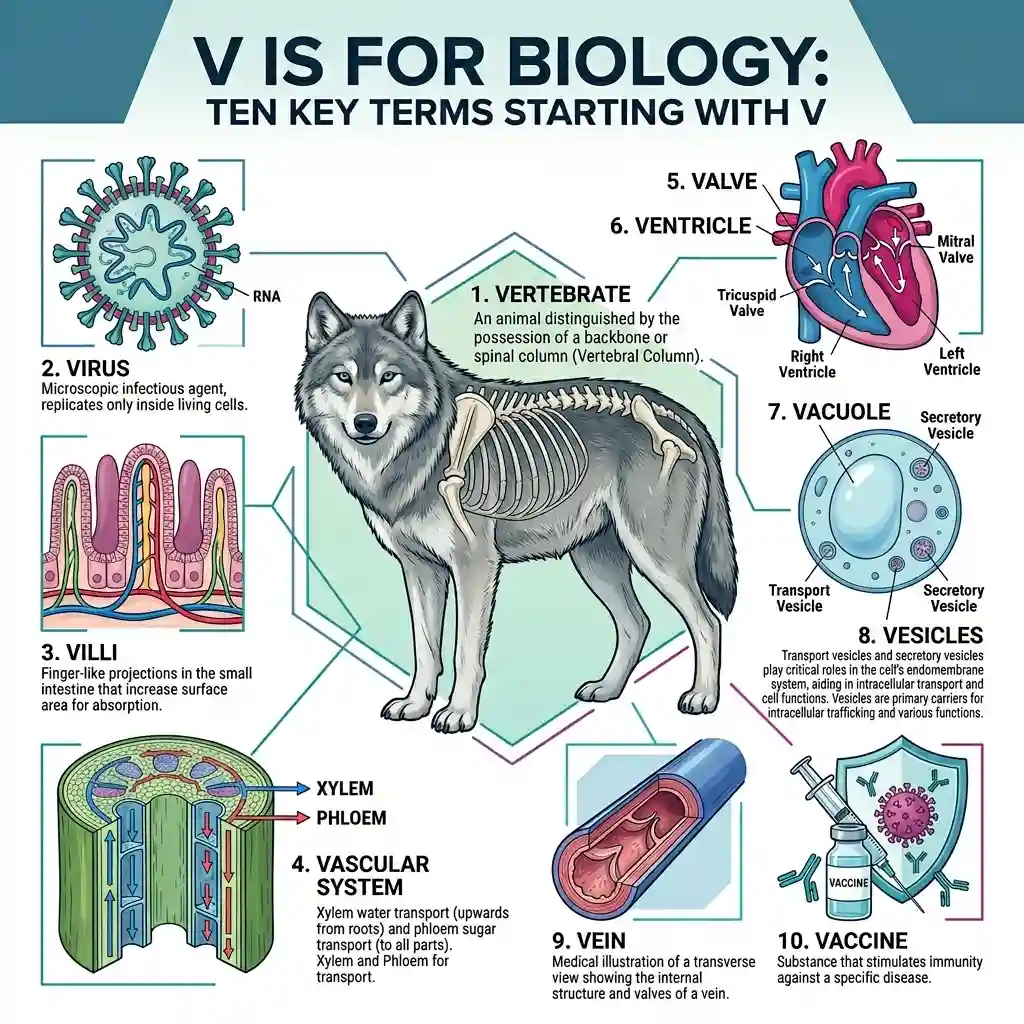
- Vacuole – Storage organelle within cells.
- Vascular Tissue – Plant tissue transporting water and nutrients.
- Vertebrate – Animal with a backbone.
- Virus – Microscopic infectious agent.
- Virology – Study of viruses.
- Variation – Differences among organisms.
- Vegetation – Plant life in an area.
- Venation – Arrangement of veins in leaves.
- Viviparous – Producing live offspring.
- Vestigial Organ – Reduced structure with little function.
- Vector Organism – Organism transmitting disease.
- Villus – Finger-like intestinal projection.
- Vital Capacity – Maximum air expelled from lungs.
- Ventral – Relating to the underside of an organism.
- Virulence – Degree of pathogen harmfulness.
- Vitelline – Related to egg yolk.
- Vivarium – Enclosure for living organisms.
- Vegetative Reproduction – Asexual plant reproduction.
- Viable – Capable of surviving.
- Vitamin – Essential nutrient for health.
Astronomy & Space Science Words That Start With V
Astronomy helps us understand planets, stars, galaxies, and the universe.
Astronomy Terms and Meanings
- Vacuum of Space – Near-empty environment between celestial bodies.
- Venus – Second planet from the Sun.
- Variable Star – Star whose brightness changes.
- Velocity Dispersion – Spread of object velocities.
- Visible Light – Portion of the electromagnetic spectrum visible to humans.
- Virgo Cluster – Large cluster of galaxies.
- Virgo Supercluster – Massive grouping of galaxy clusters.
- Voyager Probe – Spacecraft exploring outer planets.
- Void – Large empty region in space.
- Vernal Equinox – Beginning of spring in one hemisphere.
- Velocity Shift – Change in observed velocity.
- Vacuum Radiation – Radiation traveling through space.
- Visual Magnitude – Apparent brightness of celestial objects.
- Variable Nebula – Nebula with changing appearance.
- Volcanic Moon – Moon with active volcanism.
- Vesta – One of the largest asteroids.
- Velocity Field – Distribution of velocities in space.
- Visible Spectrum – Range of visible wavelengths.
- Vacuum Chamber – Simulated space environment container.
- Vapor Plume – Gas cloud emitted from a celestial body.
Earth & Environmental Science Words Starting With V
Environmental science studies Earth’s systems and ecological processes.
Earth Science Terms and Meanings
- Valley – Low land between hills or mountains.
- Vegetation Cover – Plant growth covering land.
- Volcano – Opening releasing magma and gases.
- Volcanism – Processes involving volcanic activity.
- Vapor Cycle – Movement of water vapor in nature.
- Vent – Opening through which gases escape.
- Vadose Zone – Unsaturated region above groundwater.
- Volcanic Ash – Fine particles from eruptions.
- Vegetative Buffer – Plants reducing pollution runoff.
- Vernal Pool – Seasonal wetland habitat.
- Vapor Condensation – Gas changing into liquid.
- Valley Glacier – Glacier flowing through a valley.
- Vegetation Index – Measurement of plant growth.
- Volcanic Rock – Rock formed from lava.
- Vibration Monitoring – Tracking seismic activity.
- Ventifact – Rock shaped by wind erosion.
- Viscous Lava – Thick, slow-flowing lava.
- Volcanic Cone – Cone-shaped volcanic mountain.
- Vertical Erosion – Downward cutting by water.
- Volatile Organic Compound – Easily evaporating carbon compound.
Medical & Health Science Words That Start With V
Medical science uses many V terms related to health, anatomy, and treatment.
Medical Terms and Meanings
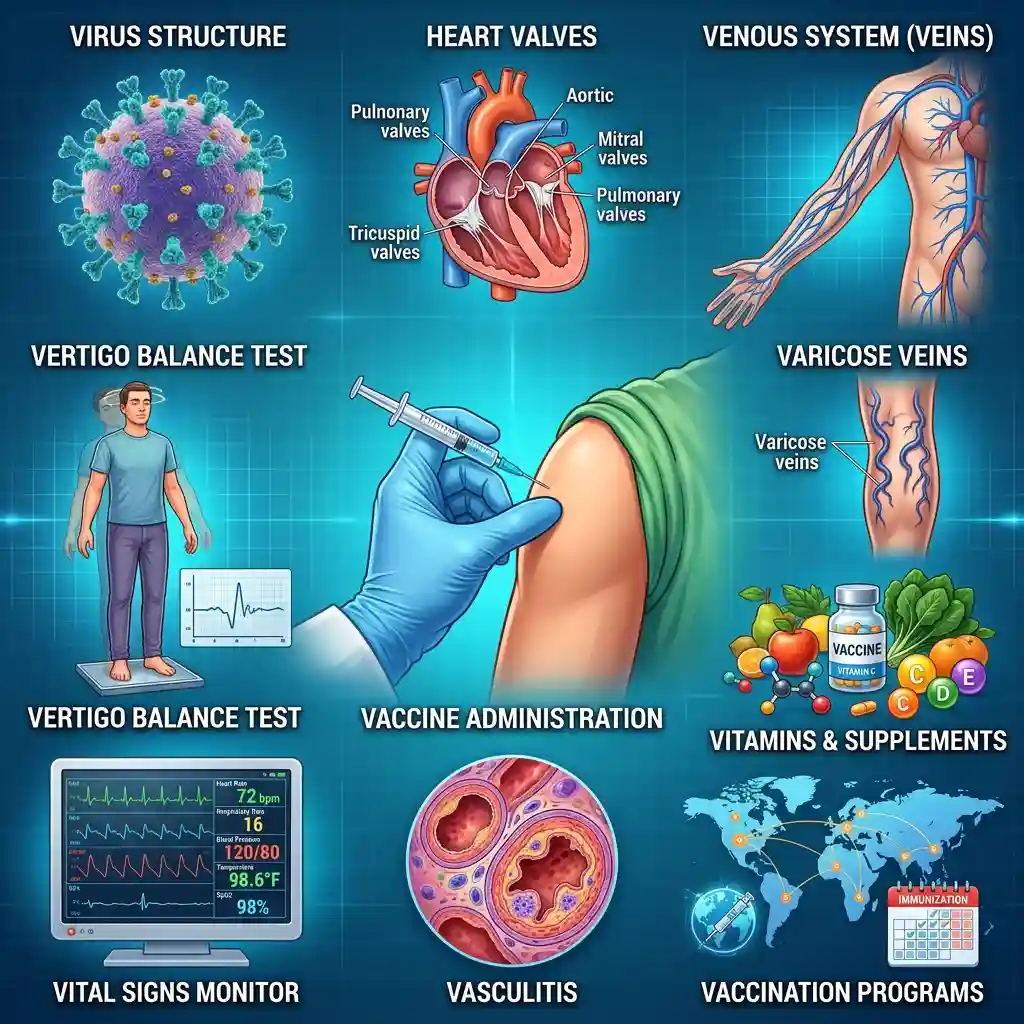
- Vaccine – Preparation that stimulates immunity.
- Vaccination – Administration of a vaccine.
- Vein – Blood vessel carrying blood to the heart.
- Ventricle – Chamber of the heart or brain.
- Virus – Disease-causing infectious agent.
- Viral Load – Amount of virus in the body.
- Vital Signs – Indicators of health status.
- Vitamin – Essential dietary nutrient.
- Vasodilation – Widening of blood vessels.
- Vasoconstriction – Narrowing of blood vessels.
- Ventilation – Movement of air in and out of lungs.
- Venipuncture – Drawing blood from a vein.
- Vertigo – Sensation of spinning dizziness.
- Viremia – Presence of viruses in blood.
- Vascular System – Network of blood vessels.
- Viability – Ability to survive.
- Vital Capacity – Maximum lung air volume.
- Vaccine Booster – Additional vaccine dose.
- Vitreous Humor – Gel filling the eye.
- Virulence Factor – Trait increasing pathogen harm.
Technology & Applied Science Words With V
Technology and engineering frequently use V-related scientific terminology.
Technology Terms and Meanings
- Virtual Reality – Computer-generated immersive environment.
- Voltage Regulator – Device controlling voltage output.
- Variable Resistor – Adjustable electrical resistor.
- Visualization – Graphical representation of data.
- Voice Recognition – Technology identifying spoken words.
- VLSI – Very Large Scale Integration in electronics.
- Vehicle Dynamics – Study of vehicle motion.
- Video Analytics – Automated analysis of video data.
- Virtual Machine – Software-based computer system.
- Verification – Process of checking correctness.
- Ventilation System – Engineered air circulation system.
- Vision Sensor – Device detecting visual information.
- Vector Graphics – Graphics based on mathematical paths.
- Vibration Sensor – Device measuring vibrations.
- Voltage Converter – Changes voltage levels.
- Virtualization – Creation of virtual systems.
- Voice Interface – Speech-based user interaction.
- Vehicle Engineering – Design and development of vehicles.
- Vacuum Pump – Device removing air or gases.
- Video Processing – Manipulation of digital video.
Easy Science Words That Start With V
These beginner-friendly words are ideal for students and young learners.
| Science Word | Simple Meaning |
|---|---|
| Vacuum | Empty space with little matter |
| Valve | Device controlling fluid flow |
| Vapor | Gas from a liquid |
| Velocity | Speed in a direction |
| Volume | Amount of space something takes |
| Virus | Tiny infectious agent |
| Vaccine | Protection against disease |
| Vitamin | Nutrient needed by the body |
| Volcano | Mountain that erupts lava |
| Valley | Low land between hills |
| Vein | Blood vessel carrying blood |
| Venus | Planet near Earth |
| Vertebrate | Animal with a backbone |
| Vibration | Back-and-forth movement |
| Vent | Opening for air or gas |
| Vortex | Swirling motion |
| Variable | Something that can change |
| Visible | Able to be seen |
| Vegetation | Plant life in an area |
| Vivarium | Place where organisms are kept |
Advanced & Technical Science Words With V
These specialized scientific terms are commonly used in higher education, research, and professional science fields.
Advanced Science Terms
- Van der Waals Interaction – Weak intermolecular attraction.
- Vacuum Fluctuation – Temporary energy changes in empty space.
- Vasomotor Regulation – Control of blood vessel diameter.
- Virulence Determinant – Genetic factor increasing pathogenicity.
- Vibrational Spectroscopy – Analysis of molecular vibrations.
- Voltammetry – Electrochemical analytical method.
- Viscoelasticity – Material property combining viscosity and elasticity.
- Vector Calculus – Mathematical study of vector fields.
- Vacuolar Transport – Cellular movement through vacuoles.
- Volcanogenic Process – Geological activity related to volcanism.
- Vitrification – Transformation into glass-like material.
- Voltage-Gated Channel – Membrane protein activated by voltage.
- Vapor Deposition – Thin-film manufacturing technique.
- Vascularization – Formation of blood vessels.
- Variational Principle – Mathematical optimization concept.
- Vacuum Polarization – Quantum field phenomenon.
- Virion Assembly – Formation of complete virus particles.
- Vector-Borne Transmission – Disease spread by carrier organisms.
- Volatile Compound Analysis – Study of easily evaporated substances.
- Vesicular Transport – Movement of materials within cells.
Fun Facts About Science Words Starting With V
- Venus is the hottest planet in our solar system, even hotter than Mercury, despite being farther from the Sun because of its dense atmosphere.
- Vaccines have saved millions of lives worldwide by helping the immune system recognize and fight dangerous diseases before infection occurs.
- Volcanoes can create entirely new landforms and islands through repeated eruptions and lava accumulation.
- Viruses are so tiny that millions can fit on the head of a pin, yet they have a huge impact on ecosystems and human health.
- Vacuums in space are not completely empty; they still contain small amounts of particles and energy.
- Vibrations help scientists study earthquakes, sound waves, and even the internal structure of planets.
FAQs About Science Words That Start With V
1. What are some common science words that start with V?
Common examples include vacuum, velocity, virus, vaccine, volume, vapor, volcano, vertebrate, vitamin, and Venus. These words are frequently used in science education.
2. Why is it important to learn science words that start with V?
Learning these terms improves scientific literacy, strengthens vocabulary, and helps students understand concepts in biology, chemistry, physics, medicine, and environmental science.
3. What is the most important physics word that starts with V?
Velocity is one of the most important physics terms because it describes both the speed and direction of an object’s motion.
4. Are there advanced scientific terms beginning with V?
Yes. Examples include vibrational spectroscopy, vacuum polarization, vector calculus, voltammetry, and viscoelasticity, which are commonly used in research and higher education.
5. How can students remember science words that start with V?
Students can create flashcards, use the words in sentences, group them by scientific field, and practice them regularly through quizzes and classroom activities.
Conclusion
Science words that start with V cover an impressive range of topics across biology, chemistry, physics, astronomy, medicine, environmental science, and technology. From everyday terms like virus and vaccine to advanced concepts such as vacuum polarization and vibrational spectroscopy, these words help explain how the natural world works. Expanding your scientific vocabulary improves understanding, communication, and academic success while making science more accessible, engaging, and rewarding for lifelong learning.
To read more: SD Meaning in Text: Proven Tips to Master SD Meaning in Text Quickly IN 2026