
Introduction
Knowledge often begins with a single word, and some of the most fascinating scientific terms start with the letter K. While this letter may seem less common than others, Science Words That Start With K play important roles across biology, chemistry, physics, medicine, astronomy, technology, and environmental science.
These terms help scientists describe natural phenomena, measure physical processes, explain discoveries, and develop innovative technologies. Learning Science Words That Start With K is an excellent way to expand both scientific understanding and vocabulary.
Why Science Words Starting With K Matter
Science vocabulary is essential for understanding how the world works. Words beginning with K appear in many scientific disciplines and help explain everything from cellular functions and chemical reactions to astronomical observations and technological innovations.
Learning these terms offers several benefits:
- Improves scientific literacy and communication skills.
- Helps students perform better in science education.
- Expands academic and technical vocabulary.
- Supports research and professional development.
- Makes complex scientific concepts easier to understand.
- Encourages curiosity about natural and technological systems.
Physics Science Words That Start With K
Physics explores matter, energy, forces, and motion. Many K-words are important in understanding physical laws and measurements.
- Kelvin — SI unit used to measure temperature.
- Kinematics — Study of motion without considering forces.
- Kinetic Energy — Energy possessed by a moving object.
- Kilogram — SI unit of mass.
- Kilowatt — Unit of power equal to 1,000 watts.
- Kilojoule — Unit of energy measurement.
- Kinetic Friction — Friction acting between moving surfaces.
- Keplerian Motion — Planetary motion described by Kepler’s laws.
- Klystron — Microwave amplification device.
- Kernel Function — Mathematical function used in physics modeling.
- Knudsen Number — Dimensionless number in fluid dynamics.
- Kink Instability — Plasma instability phenomenon.
- Kerr Effect — Change in refractive index due to an electric field.
- Kilonewton — Unit of force equal to 1,000 newtons.
- Kinetic Theory — Theory explaining gas behavior through particle motion.
- K-shell Electron — Electron occupying the innermost shell.
- K-factor — Multiplication factor in nuclear physics.
- Klystron Oscillator — Device generating microwave frequencies.
- Kinetic Momentum — Momentum associated with motion.
- Kaon — Subatomic particle studied in particle physics.
Chemistry Science Words That Start With K
Chemistry focuses on substances, elements, and reactions. The following K terms are commonly encountered in chemical science.
- Potassium (K) — Essential chemical element with atomic number 19.
- Kaolinite — Clay mineral used in industrial applications.
- Ketone — Organic compound containing a carbonyl group.
- Katalyst (Catalyst) — Substance that speeds up reactions.
- Kjeldahl Method — Technique for measuring nitrogen content.
- Krypton — Noble gas element.
- Kinetics — Study of reaction rates.
- Kohlrausch Law — Principle related to electrolyte conductivity.
- Kerosene — Hydrocarbon fuel derived from petroleum.
- Kyanite — Aluminum silicate mineral.
- Kappa Number — Measure of lignin in pulp processing.
- Ketyl Radical — Reactive intermediate in organic chemistry.
- Keggin Structure — Polyoxometalate molecular arrangement.
- Kumada Coupling — Organic synthesis reaction.
- Ketenes — Reactive organic compounds.
- Krypton Fluoride — Compound involving krypton and fluorine.
- Kaolin — Fine clay used in manufacturing.
- Kinetic Molecular Theory — Model explaining gas behavior.
- K-Edge — Absorption edge in spectroscopy.
- Kharasch Effect — Chemical reaction phenomenon involving radicals.
Biology Science Words That Start With K
Biology studies living organisms and life processes. Many K-terms are important in genetics, anatomy, and ecology.
- Kingdom — Major biological classification group.
- Keratin — Structural protein in skin, hair, and nails.
- Kidney — Organ that filters blood and produces urine.
- Karyotype — Complete chromosome profile of an organism.
- Kinase — Enzyme that transfers phosphate groups.
- Krebs Cycle — Cellular respiration pathway.
- Kinesis — Movement response to environmental stimuli.
- Kupffer Cell — Specialized liver immune cell.
- Karyoplasm — Material within a cell nucleus.
- Karyokinesis — Nuclear division during cell reproduction.
- K-strategist — Species producing fewer offspring with greater care.
- Keratocyte — Cell involved in corneal maintenance.
- Kin Selection — Evolutionary strategy favoring relatives.
- Kelp — Large brown marine algae.
- Karyology — Study of chromosomes.
- Keratogenesis — Formation of keratin tissue.
- Knuckle-walking — Locomotion method of some primates.
- Kinetochore — Chromosome structure aiding cell division.
- Kuru — Rare neurological disease.
- Karyotype Analysis — Examination of chromosomes for abnormalities.

Astronomy & Space Science Words That Start With K
Astronomy investigates celestial objects and the universe.
- Kepler’s Laws — Laws describing planetary motion.
- Kuiper Belt — Region of icy bodies beyond Neptune.
- Kiloparsec — Astronomical distance unit.
- Kilonova — Explosive event from neutron star mergers.
- Keck Observatory — Major astronomical observatory.
- K-type Star — Orange-colored main sequence star.
- Kepler Mission — Exoplanet discovery mission.
- Krakatoa Event — Volcanic eruption studied in planetary science.
- Kuiper Object — Body located in the Kuiper Belt.
- Keplerian Orbit — Orbit following Kepler’s laws.
- K-band — Infrared observation wavelength range.
- KBO — Kuiper Belt Object.
- K2 Mission — Extended Kepler space mission.
- Kelvin-Helmholtz Contraction — Stellar energy mechanism.
- Kirkwood Gaps — Gaps within the asteroid belt.
- Kinetic Impact — Method for asteroid deflection.
- Kilonova Remnant — Material left after a kilonova.
- Kappa Mechanism — Stellar pulsation process.
- Kinematic Distance — Distance estimated from motion.
- Koronis Family — Asteroid family in the solar system.
Earth & Environmental Science Words Starting With K
Environmental science helps explain Earth’s systems and ecosystems.
- Karst — Landscape formed by dissolving rock.
- Kaolin Soil — Soil rich in kaolin minerals.
- Kettle Lake — Lake formed by retreating glaciers.
- Kame — Glacially deposited hill.
- Kelp Forest — Underwater ecosystem dominated by kelp.
- Katabatic Wind — Downslope wind caused by cooling.
- Karstification — Formation process of karst landscapes.
- Kyanite Deposit — Geological mineral accumulation.
- Krakatoa Ash — Volcanic material from eruptions.
- Kilobar — Unit of pressure.
- Kaolinite Clay — Naturally occurring clay mineral.
- Knickpoint — Sharp change in river gradient.
- Karst Aquifer — Water-bearing karst formation.
- Kurgan Soil — Soil associated with ancient burial mounds.
- Köppen Climate Classification — Climate categorization system.
- Kettle Hole — Depression left by glaciers.
- Kinetic Weathering — Weathering through physical movement.
- Kimberlite — Rock often containing diamonds.
- Kelp Ecosystem — Marine habitat structure.
- Karst Spring — Spring emerging from limestone terrain.
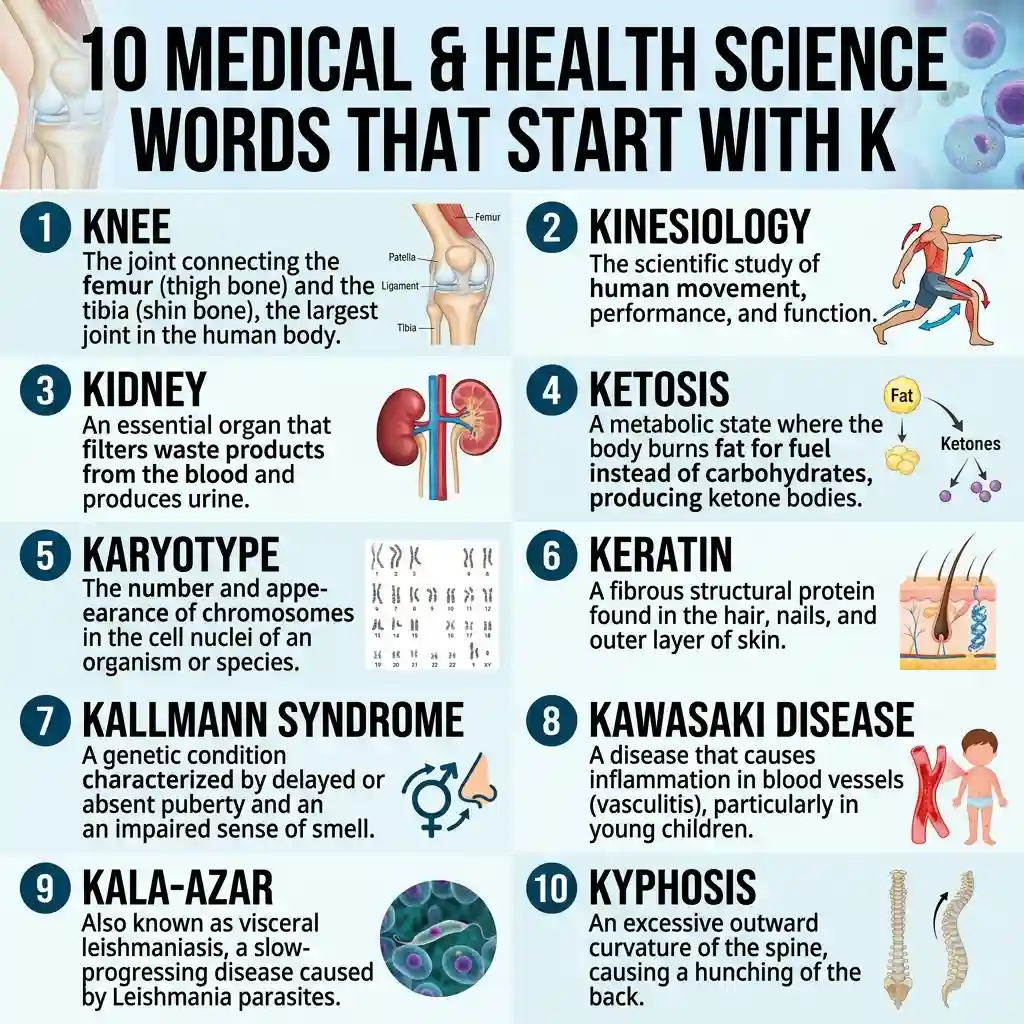
Medical & Health Science Words That Start With K
Medical science uses many K-related terms in anatomy, nutrition, and disease studies.
- Kidney — Organ responsible for filtration.
- Keratitis — Inflammation of the cornea.
- Karyotyping — Chromosome analysis procedure.
- Ketosis — Metabolic state using fat for energy.
- Kwashiorkor — Severe protein deficiency disorder.
- Keratinocyte — Primary skin cell.
- Kinesiology — Study of human movement.
- Kallikrein — Enzyme involved in blood regulation.
- Keratoplasty — Corneal transplant surgery.
- Kyphosis — Excessive spinal curvature.
- Keratoconus — Progressive eye disorder.
- Kidney Stone — Hard mineral deposit in kidneys.
- Kuru Disease — Rare neurological condition.
- Kinesitherapy — Movement-based therapy.
- Karyolysis — Dissolution of a cell nucleus.
- Ketonuria — Presence of ketones in urine.
- Keratoderma — Thickening of skin.
- Kleptomania — Impulse control disorder.
- Keratoma — Thickened skin lesion.
- Karyomegaly — Enlargement of cell nuclei.
Technology & Applied Science Words With K
Technology and engineering use K-terms in computing, electronics, and innovation.
- Kernel — Core component of an operating system.
- Kilobyte — Unit of digital information.
- Kilobit — Digital data measurement unit.
- Kubernetes — Container orchestration platform.
- Knowledge Base — Organized information repository.
- Keyframe — Animation reference frame.
- Keyword Algorithm — Search and indexing process.
- Kinematic Design — Engineering design based on motion.
- Keystroke Dynamics — Behavioral biometric technology.
- Klystron Tube — Microwave electronics component.
- Knowledge Engineering — Development of expert systems.
- Kernel Programming — Operating system development.
- Kinetic Sculpture — Motion-based engineering artwork.
- Key Distribution — Cryptographic security process.
- Kilohertz — Frequency unit equal to 1,000 hertz.
- Knowledge Graph — Structured relationship database.
- Keyboard Interface — Input system technology.
- Kinematic Simulation — Motion modeling software.
- Kiosk Technology — Interactive digital station.
- Key Management — Cryptographic key control.
Easy Science Words That Start With K
These beginner-friendly science terms are perfect for students and young learners.
| Word | Meaning |
|---|---|
| Kelvin | Unit of temperature |
| Kelp | Large seaweed |
| Kidney | Organ that filters blood |
| Kernel | Core part of a system |
| Kilogram | Unit of mass |
| Kilowatt | Unit of power |
| Kinetic | Related to motion |
| Kingdom | Biological classification group |
| Krypton | Chemical element |
| Kaolin | Soft white clay |
| Kettle Lake | Glacial lake |
| Karyotype | Chromosome picture |
| Ketone | Organic compound |
| Kinesis | Movement response |
| Karst | Limestone landscape |
| Kilobit | Data unit |
| Kilobyte | Digital storage unit |
| Kame | Glacial hill |
| Karyology | Chromosome study |
| Kepler | Famous astronomer term |
Advanced & Technical Science Words With K
Advanced scientific vocabulary often appears in research papers and higher education.
- Kinetochore — Protein structure controlling chromosome separation.
- Kerr Effect — Electro-optical phenomenon.
- Kappa Mechanism — Stellar pulsation process.
- Klystron — Microwave vacuum tube.
- Karyokinesis — Nuclear division process.
- Knudsen Number — Fluid dynamics parameter.
- Keggin Structure — Molecular architecture in chemistry.
- Kohlrausch Law — Electrolyte conductivity principle.
- Ketyl Radical — Organic chemistry intermediate.
- Kirkwood Gaps — Orbital gaps in the asteroid belt.
- Kelvin-Helmholtz Instability — Fluid instability phenomenon.
- Karyomegaly — Enlarged cell nuclei condition.
- Kaon — Meson particle.
- K-factor — Nuclear multiplication parameter.
- Karyoplasm — Nuclear cell substance.
- Kumada Coupling — Cross-coupling reaction.
- Kinetic Monte Carlo — Computational simulation method.
- K-Edge Spectroscopy — X-ray absorption analysis.
- Klystron Oscillator — High-frequency signal generator.
- Kinetic Isotope Effect — Reaction rate variation due to isotopes.
Fun Facts About Science Words That Start With K
1. Kelvin Is Named After a Scientist
The Kelvin temperature scale was named after physicist Lord Kelvin. It begins at absolute zero, the coldest theoretically possible temperature.
2. The Kuiper Belt Is Full of Icy Worlds
Thousands of icy objects orbit the Sun in the Kuiper Belt, including the dwarf planet Pluto.
3. Keratin Makes Hair Strong
Keratin is the same protein found in human hair, nails, and animal claws, helping provide strength and protection.
4. Kelp Forests Support Marine Life
Kelp forests are among Earth’s most productive ecosystems and provide shelter for countless marine species.
5. Kilonova Explosions Create Heavy Elements
Scientists believe many precious metals, including gold and platinum, are formed during kilonova events.
FAQs About Science Words That Start With K
1. What are some common science words that start with K?
Common examples include Kelvin, kinetic energy, kingdom, kidney, keratin, kelp, krypton, and kinematics. These terms appear across many scientific disciplines.
2. Why is Kelvin important in science?
Kelvin is the international SI unit for temperature measurement. Scientists use it because it begins at absolute zero and provides accurate thermodynamic calculations.
3. What biology words start with K?
Biology terms include kingdom, keratin, kinase, kidney, karyotype, kelp, kinetochore, and Krebs cycle.
4. Are there astronomy terms that start with K?
Yes. Examples include Kuiper Belt, kilonova, Kepler’s laws, K-type star, Kirkwood gaps, and Kepler Mission.
5. How can learning science vocabulary improve scientific knowledge?
Scientific vocabulary helps readers understand textbooks, research papers, experiments, and classroom discussions more effectively while improving communication skills.
Conclusion
Science Words That Start With K demonstrate how a single letter can connect diverse fields such as physics, chemistry, biology, astronomy, medicine, environmental science, and technology. From Kelvin and kinetic energy to Kuiper Belt and keratin, these terms help explain important scientific concepts and discoveries.
Expanding your knowledge of scientific vocabulary improves comprehension, communication, and academic success. By learning these words, readers gain a stronger foundation for exploring the fascinating world of science.
To read more:20 Incredible Science Words That Start With P to Expand Your Vocabulary