
Have you ever met someone who talks to their plants, collects 500 rubber ducks, or wears a cape to the grocery store? How would you describe them in English?
You could just say “weird” but that’s a bit boring! English has dozens of colorful idioms for weird that make your words more fun and memorable.
In this guide, you’ll learn 70+ idioms for weird, bizarre expressions, and strange sayings used in everyday English. Whether you’re an ESL learner, a student, or a teacher, this article has something for you.
By the end, you’ll know exactly how to use quirky phrases and peculiar idioms like a native speaker. Let’s dive in!
What Are Idioms for Weird?
Idioms for weird are phrases where the meaning is different from the literal words. For example, “off the wall” doesn’t mean something is physically on a wall it means something is very strange or unusual.
We use idioms instead of plain words because they’re more vivid, fun, and expressive. They make language come alive!
Fun fact: English has over 25,000 idioms, according to the Cambridge Dictionary. Many of them describe odd behavior, eccentric people, and unusual situations.
These figurative language tools are part of colloquial (everyday) speech. They have a non-literal meaning that you must learn in context.
Origin and History of Popular Weird Idioms
Where did these strange expressions come from? Let’s look at a few!
1. “Off the Wall”
This phrase comes from American English in the 1950s. It likely came from squash or handball, where a ball bouncing unpredictably off the wall was hard to control just like an unpredictable person.
2. “Oddball”
The word “oddball” appeared in the 1940s in American English. It compared a person to an odd (strange) ball in sports that didn’t behave like normal balls.
3. “Barking Mad”
This British idiom comes from the old Barking Asylum in Essex, England. People used to say someone was “from Barking” to mean they were crazy.
4. “A Few Sandwiches Short of a Picnic”
This funny British idiom appeared in the 1980s. It describes someone whose thinking seems incomplete like a picnic missing its sandwiches.
5. “Touched in the Head”
This phrase goes back centuries. “Touched” was an old way to say someone’s mind had been “touched” by something supernatural or unusual.
Top 20 Most Common Idioms for Weird
Here are the 20 most popular idioms for weird weird in English. Each one comes with a clear meaning, example, and helpful tip.
1. Off the Wall
- Meaning: Very strange or unusual
- Origin: From American sports slang in the 1950s
- Example: “His idea for a flying car made of cheese was totally off the wall.”
- When to use it: When someone has a crazy or unexpected idea
- Tip: This is informal don’t use it in a formal essay or business email
2. Out in Left Field
- Meaning: Strange, unexpected, or far from normal
- Origin: From American baseball left field is far from home plate
- Example: “Her answer came out of left field nobody expected it!”
- When to use it: When something is surprisingly odd or random
- Tip: Common in American English; less understood in British English
3. Oddball
- Meaning: A person who behaves in a strange or eccentric way
- Origin: American English from the 1940s
- Example: “He’s a total oddball he only eats square-shaped food.”
- When to use it: To describe a quirky person in a lighthearted way
- Tip: Can be affectionate or mildly rude depending on your tone
4. Barking Mad
- Meaning: Completely crazy or very strange (British)
- Origin: Linked to the Barking Asylum in Essex, England
- Example: “You jumped into a frozen lake for fun? You’re barking mad!”
- When to use it: For funny, extreme situations in casual British conversation
- Tip: This is a British idiom; Americans might say “absolutely nuts” instead
5. A Few Sandwiches Short of a Picnic
- Meaning: Not very smart or a little “out there” mentally
- Origin: British slang from the 1980s
- Example: “He thinks the moon is made of cheese he’s a few sandwiches short of a picnic.”
- When to use it: As a funny, gentle way to describe someone who’s a bit off
- Tip: Humorous, not mean-spirited use it with a smile!
6. Touched in the Head
- Meaning: A bit crazy or mentally unusual
- Origin: Old English expression about the mind being affected
- Example: “She talks to her socks. I think she’s a little touched in the head.”
- When to use it: For describing very quirky behavior in a casual way
- Tip: Old-fashioned but still widely understood
7. Not Playing with a Full Deck
- Meaning: Not thinking clearly; acting strangely
- Origin: American English; a full deck of cards = a complete, working mind
- Example: “He drove to work with his dog on the roof. He’s not playing with a full deck!”
- When to use it: When someone makes a bizarre or foolish choice
- Tip: Can sound rude use it carefully with people you know well
8. Wacky
- Meaning: Funny and strange in an amusing way
- Origin: From English dialect; possibly related to “whack” (a blow)
- Example: “That cartoon is so wacky the dog drives a spaceship!”
- When to use it: For lighthearted, funny weirdness
- Tip: More positive than “crazy” implies fun weirdness
9. Out to Lunch
- Meaning: Confused, out of touch with reality, or acting oddly
- Origin: American English slang from the 1950s-60s
- Example: “He forgot his own birthday. He’s totally out to lunch.”
- When to use it: When someone seems confused or disconnected
- Tip: Don’t confuse with literally being away at lunch!
10. Strange Bird
- Meaning: A person who is unusual or hard to understand
- Origin: Common English phrase; birds are often seen as free and unpredictable
- Example: “My uncle collects antique spoons, he’s a strange bird.”
- When to use it: When someone is peculiar but harmless
- Tip: Often said with affection, not criticism
11. Have a Screw Loose
- Meaning: Acting in a crazy or irrational way
- Example: “She glued googly eyes to all the office chairs. She must have a screw loose!”
- Tip: Very common most native speakers will recognize it immediately
12. Loopy
- Meaning: Silly, confused, or a little crazy
- Example: “After staying up all night, I felt completely loopy.”
- Tip: Can describe a person OR a temporary feeling of silliness
13. Batty
- Meaning: Slightly crazy or eccentric
- Example: “My neighbor is a bit batty — she names all her houseplants after famous scientists.”
- Tip: Common in British English; comes from “bats in the belfry”
14. Bonkers
- Meaning: Crazy or very strange
- Example: “That movie plot was absolutely bonkers I loved every second!”
- Tip: Very versatile works for people, situations, and ideas
15. Quirky
- Meaning: Unusual in a charming or interesting way
- Example: “She has a quirky habit of always wearing mismatched socks.”
- Tip: This is generally a positive word quirky = interestingly odd
16. Cuckoo
- Meaning: Crazy or wildly strange
- Example: “He quit his job to become a professional wizard. Is he cuckoo?”
- Tip: Based on the cuckoo bird, which has unusual behavior
17. Out of This World
- Meaning: So amazing or unusual that it seems otherworldly
- Example: “Her fashion sense is totally out of this world always unexpected!”
- Tip: Can be positive great food or art can also be “out of this world”
18. One Brick Short of a Load
- Meaning: Not quite mentally sharp; a little strange
- Example: “He tried to microwave his cell phone. He must be one brick short of a load.”
- Tip: Part of a large family of idioms using “short of a full X”
19. Marching to the Beat of a Different Drummer
- Meaning: Living or thinking in a unique, unconventional way
- Example: “She opened a tea shop on Mars (in a video game). She always marches to the beat of a different drummer.”
- Tip: Usually positive it celebrates individuality
20. Freaky
- Meaning: Strange in a way that surprises or slightly disturbs
- Example: “It’s kind of freaky how twins sometimes think the same thoughts.”
- Tip: Can be positive or negative depending on context and tone
Rare and Unique Idioms for Weird
These unusual idioms for weird add depth to your vocabulary. You won’t find many of them in beginner books!
British Idioms
- Doolally — Acting strangely or mentally confused. “He’s gone completely doolally since he won the lottery.” (British)
- Crackers — Crazy or very odd. “You want to swim in December? You’re crackers!” (British)
- Potty — Silly or slightly mad. “He’s gone potty over his new hobby.” (British)
- Daft as a brush — Very silly or foolish. “Don’t listen to him he’s daft as a brush.” (British)
American Idioms
- Weirdo — A very strange person. “Only a weirdo would eat pizza with chopsticks.” (American)
- Flipped out — Reacted in an extreme or bizarre way. “She flipped out when she saw the spider.” (American)
- Spacey — Dreamy, unfocused, or acting strangely. “He seemed spacey all morning like he wasn’t really there.” (American)
Other Rare Idioms
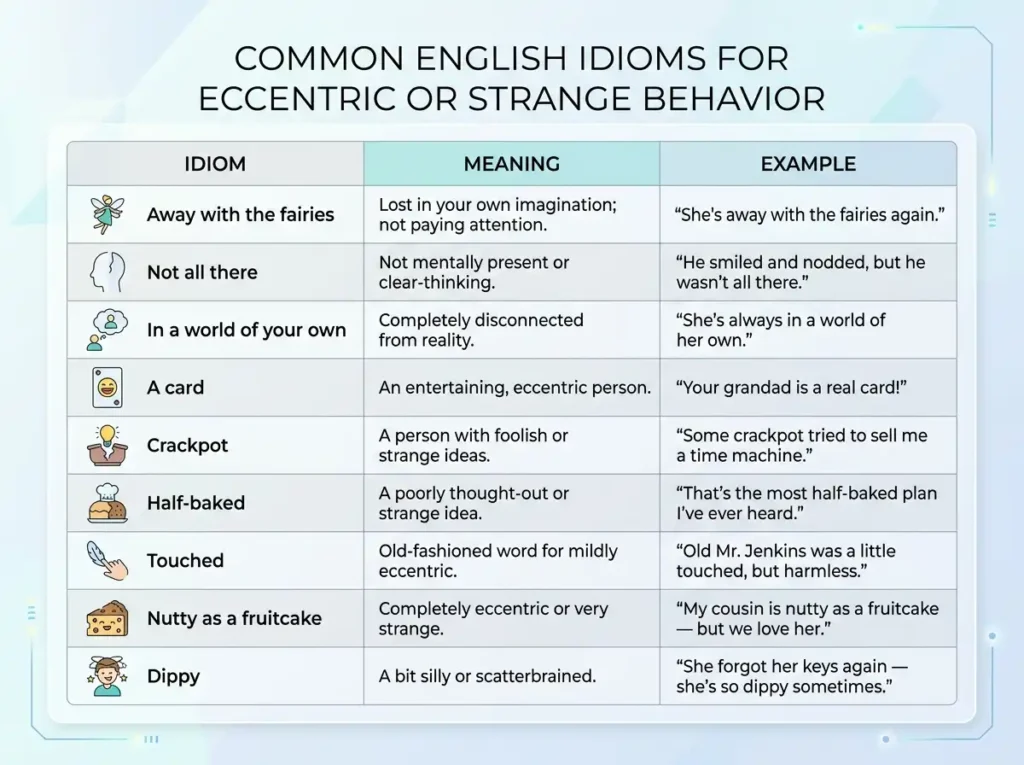
- Away with the fairies — Lost in your own imagination; not paying attention. “She’s away with the fairies again.”
- Not all there — Not mentally present or clear-thinking. “He smiled and nodded, but he wasn’t all there.”
- In a world of your own — Completely disconnected from reality. “She’s always in a world of her own.”
- A card — An entertaining, eccentric person. “Your grandad is a real card!”
- Crackpot — A person with foolish or strange ideas. “Some crackpot tried to sell me a time machine.”
- Half-baked — A poorly thought-out or strange idea. “That’s the most half-baked plan I’ve ever heard.”
- Touched — Old-fashioned word for mildly eccentric. “Old Mr. Jenkins was a little touched, but harmless.”
- Nutty as a fruitcake — Completely eccentric or very strange. “My cousin is nutty as a fruitcake but we love her.”
- Dippy — A bit silly or scatterbrained. “She forgot her keys again she’s so dippy sometimes.”
Idioms for Weird from Books, Movies, and Pop Culture
These idioms for weird appear in famous media. Learning them helps you sound like a true English speaker!
1. “Off the Wall” — Michael Jackson (Album Title, 1979)
Michael Jackson’s album Off the Wall celebrated being creative and different. Today, “off the wall” means a wild or eccentric idea.
Example: “His plan to build a treehouse underwater was totally off the wall.”
2. “One Flew Over the Cuckoo’s Nest” — Novel/Film
This famous story uses the idea of a cuckoo (a bird seen as crazy) to describe an unusual mental health ward. It gave us the phrase “cuckoo’s nest” for a chaotic, weird place.
Example: “That office is like a cuckoo’s nest everyone acts strange.”
3. “Willy Wonka” — Charlie and the Chocolate Factory
Roald Dahl’s eccentric character Willy Wonka became a symbol of delightful weirdness. People say someone is “a real Willy Wonka” to mean they’re creative and very unusual.
Example: “Our science teacher is such a Willy Wonka he teaches with magic tricks!”
4. “Looney Tunes” — Cartoon
The word “looney” (or “loony”) means crazy or silly. It comes partly from “lunatic” and was popularized by Looney Tunes cartoons. Today, calling something “loony” means it’s very silly.
Example: “That rule is loony who bans laughing at school?”
5. “Mad Hatter” — Alice in Wonderland
The Mad Hatter from Lewis Carroll’s story became the ultimate symbol of bizarre behavior. Calling someone a “Mad Hatter” means they act in a wild, unpredictable way.
Example: “He rearranged the whole kitchen at midnight total Mad Hatter behavior.”
6. “Out There” — Common Modern Slang
In many TV shows and movies, characters say “that’s really out there” to mean something is extremely weird or hard to believe.
Example: “Your theory about time-traveling cats is a bit out there.”
7. “Stranger Things” — TV Show
The show popularized the phrase “the upside down” to describe anything weird, reversed, or abnormal.
Example: “My schedule this week is like the upside down everything is backwards.”
8. “Going Down the Rabbit Hole” — Alice in Wonderland
This idiom means entering a strange, confusing, or obsessive situation just like Alice did when she followed the rabbit.
Example: “I went down a rabbit hole researching conspiracy theories online.”
How to Use Weird Idioms Correctly
Knowing an idiom is step one. Using it correctly is the important part!
Do This vs. Don’t Do This
| ✅ Do This | ❌ Don’t Do This |
| Use idioms in casual conversation with friends | Use idioms in formal essays or job applications |
| Match the idiom’s tone — playful vs. rude | Use negative idioms to hurt someone’s feelings |
| Learn if it’s British or American first | Assume all English speakers know all idioms |
| Use context clues to check if it fits | Force an idiom in when it doesn’t fit naturally |
| Practice with one idiom at a time | Try to use 5 idioms in one sentence — it sounds forced |
Formal vs. Informal
- Informal (OK): “My cousin is totally off the wall I love him for it!”
- Formal (NOT OK): “The candidate’s proposal was off the wall.” ← Use “unconventional” instead
Example Conversations
Conversation 1:
“Did you hear about Jake’s plan to cycle across the ocean?”
“I know! He’s completely bonkers. But honestly, I think he might actually do it.”
Conversation 2:
“Ms. Parker came to school in a full astronaut suit today.”
“Ha! She’s always marching to the beat of a different drummer. I love her class.”
Idioms for Weird by Category
Idioms for Weird People
- Oddball — A quirky, unusual person
- Strange bird — Someone hard to understand
- Crackpot — A person with strange ideas
- Weirdo — Informal word for a very strange person
- A card — An entertaining eccentric
- Mad Hatter — A wildly unpredictable person
Idioms for Weird Situations
- Off the wall — A very strange situation or idea
- Out in left field — Something unexpectedly strange
- Down the rabbit hole — A strange, confusing situation
- Out of this world — An unbelievably strange (or amazing) situation
- Going cuckoo’s nest — A chaotic, odd environment
Idioms for Weird Behavior
- Barking mad — Acting in a wildly crazy way
- Not playing with a full deck — Behaving irrationally
- Flipped out — Reacted in a sudden, extreme, or bizarre way
- Have a screw loose — Acting in an unstable or irrational way
- Away with the fairies — Lost in imagination; not focused
Idioms for Weird Feelings
- Out to lunch — Feeling confused or disconnected
- Loopy — Feeling silly, giddy, or out of it
- Spacey — Feeling unfocused or dreamy
- In a world of your own — Feeling mentally disconnected
- Freaky — Feeling strange or unsettled
Synonyms and Related Words for Weird
Here are 15 useful words related to “weird” with their meanings and examples.
| Word | Meaning | Example Sentence |
| Strange | Unusual or hard to explain | That strange noise came from the attic. |
| Bizarre | Very strange and hard to understand | The artist painted bizarre pictures of flying furniture. |
| Eccentric | Unusual in a charming or interesting way | The professor was eccentric — he taught in pajamas. |
| Peculiar | Odd in a specific, noticeable way | There was a peculiar smell in the old bookshop. |
| Outlandish | Very strange and foreign-looking | Her outlandish costume turned every head at the party. |
| Quirky | Unusual in a fun, charming way | His quirky humor made everyone laugh. |
| Uncanny | Strange in an eerie, almost supernatural way | It’s uncanny how much they look alike. |
| Eerie | Strange and frightening | The empty playground at night felt eerie. |
| Freakish | Very unusual or abnormal | The freakish weather surprised even the meteorologists. |
| Abnormal | Different from what is normal | The scientist noticed abnormal growth in the plants. |
| Offbeat | Unconventional, not following the usual style | Her offbeat fashion sense was inspiring. |
| Unconventional | Not following traditional rules | He took an unconventional approach to solving the puzzle. |
| Curious | Strange and interesting | What a curious little shop full of old clocks! |
| Mysterious | Hard to explain or understand | A mysterious figure appeared at the door. |
| Otherworldly | Seeming to be from another world | The music had an otherworldly, dreamlike quality. |
Complete List of Idioms for Weird — Quick Reference
Here’s your cheat sheet! All idioms in one place.
- Off the wall — Very strange or unusual
- Out in left field — Unexpectedly odd or random
- Oddball — A quirky, eccentric person
- Barking mad — Completely crazy (British)
- A few sandwiches short of a picnic — Not quite mentally all there
- Touched in the head — Slightly crazy
- Not playing with a full deck — Acting irrationally
- Wacky — Funny and strange
- Out to lunch — Confused or disconnected
- Strange bird — A peculiar, hard-to-understand person
- Have a screw loose — Acting in a crazy way
- Loopy — Feeling silly or out of it
- Batty — Slightly crazy (British)
- Bonkers — Crazy or very strange
- Quirky — Unusual in a charming way
- Cuckoo — Wildly strange or crazy
- Out of this world — Amazingly unusual
- One brick short of a load — Not fully thinking straight
- Marching to the beat of a different drummer — Living unconventionally
- Freaky — Strange and surprising
- Doolally — Mentally confused (British)
- Crackers — Crazy or odd (British)
- Potty — Silly or slightly mad (British)
- Daft as a brush — Very silly (British)
- Weirdo — A very strange person (American)
- Flipped out — Reacted in a bizarre way (American)
- Spacey — Unfocused or dreamy (American)
- Away with the fairies — Lost in imagination
- Not all there — Not mentally present
- In a world of your own — Completely disconnected
- A card — An entertaining eccentric
- Crackpot — A person with strange ideas
- Half-baked — A poorly thought-out idea
- Nutty as a fruitcake — Completely eccentric
- Dippy — Silly or scatterbrained
- Down the rabbit hole — Entering a strange situation
- Mad Hatter — Wildly unpredictable
Quiz: Test Your Knowledge of Weird Idioms!
Answer these 10 questions to see how well you know your weird idioms.
1. Your classmate insists that his hamster is a secret government spy. Which idiom fits best?
- A) Out of this world
- B) Not playing with a full deck
- C) Strange bird
- D) Out to lunch
Answer: B
2. Your friend always wears a banana suit to school. Which idiom fits?
- A) Off the wall
- B) Out in left field
- C) Barking mad
- D) All of the above
Answer: D
3. Which idiom is specifically British?
- A) Out in left field
- B) Barking mad
- C) Spacey
- D) Weirdo
Answer: B
4. Which idiom would you use to describe someone’s charming, unusual habits in a positive way?
- A) Crackpot
- B) Weirdo
- C) Quirky
- D) Loopy
Answer: C
5. “After three all-nighters, she felt totally _______ laughing at everything.” Which idiom fits?
- A) Out to lunch
- B) Loopy
- C) Doolally
- D) Both B and C
Answer: D
6. You’re reading about a tiny village where everyone keeps pet dragons. You might say the story is:
- A) Out in left field
- B) Down the rabbit hole
- C) Out of this world
- D) Half-baked
Answer: C
7. Which idiom connects to the novel Alice in Wonderland?
- A) Off the wall
- B) Barking mad
- C) Going down the rabbit hole
- D) Marching to the beat of a different drummer
Answer: C
8. “He tried to cook pasta in the dishwasher. He must _______.” Which fits best?
- A) Have a screw loose
- B) Be away with the fairies
- C) Be a strange bird
- D) Be quirky
Answer: A
9. Which of these is safe and positive to use about a creative friend?
- A) Crackpot
- B) Barking mad
- C) Marching to the beat of a different drummer
- D) Not playing with a full deck
Answer: C
10. Which idiom means someone’s idea is poorly thought-out or incomplete?
- A) Half-baked
- B) Spacey
- C) Strange bird
- D) Freaky
Answer: A
Frequently Asked Questions (FAQs)
What are the most common idioms for weird?
The most common weird idioms include “off the wall,” “bonkers,” “out in left field,” “oddball,” and “barking mad.” These are used widely in everyday English by both British and American speakers.
How do you describe a weird person using idioms?
You can call someone an “oddball,” a “strange bird,” a “crackpot,” or say they’re “not playing with a full deck.” For a positive spin, try “quirky” or “marching to the beat of a different drummer.”
What idiom means strange behavior?
“Have a screw loose” and “barking mad” both describe strange behavior. “Away with the fairies” works for someone who seems dreamy and disconnected from reality.
Are these idioms used in formal English?
No! Almost all weird idioms are informal. In formal writing like essays, reports, or business emails — use plain words: strange, unusual, unconventional, or eccentric instead.
What is the difference between weird and bizarre idioms?
“Weird” idioms describe things that are a little unusual (quirky, bonkers). “Bizarre” implies something even more unexpected and hard to explain, like “out of this world” or “down the rabbit hole.”
Can kids use these idioms?
Yes! Many idioms like “wacky,” “quirky,” and “loopy” are totally kid-friendly. Some like “not playing with a full deck” can sound rude, so kids should check with a teacher before using those.
Where can I learn more about English idioms?
Great resources include the Cambridge Dictionary (dictionary.cambridge.org) and Merriam-Webster (merriam-webster.com). Both have excellent idiom sections for learners.
What’s a funny idiom for a weird person?
Try “a few sandwiches short of a picnic” or “nutty as a fruitcake.” Both are lighthearted and funny great for casual conversations with friends.
Conclusion
Wow you made it through 70+ idioms for weird! You’ve learned strange sayings, bizarre expressions, and unusual phrases from both British and American English. You now know how to describe weird people, odd situations, and quirky behavior like a real English speaker.
You can use idioms from books, movies, and everyday conversations. Here’s your challenge: pick ONE idiom you love and use it today. Tell a friend someone is “off the wall” or say a situation is “totally bonkers.”
Which idiom is your new favorite? Drop it in the comments below we’d love to hear it!